Digital Twins: From Buzzword to Reality
- Gerard Webb
- Industry , Digital twins
- August 25, 2024
Table of Contents
“Digital twin” might be the most overused term in industrial technology.
Vendors slap it on everything from 3D visualizations to simple dashboards. If your product touches physical assets, marketing calls it a digital twin.
But here’s the thing: real digital twins are transformative. The buzzword exists because the concept is genuinely valuable.
The gap between marketing and reality is where the opportunity lives.
What a Digital Twin Actually Is
A digital twin isn’t a 3D model. It isn’t a dashboard. It isn’t a simulation.
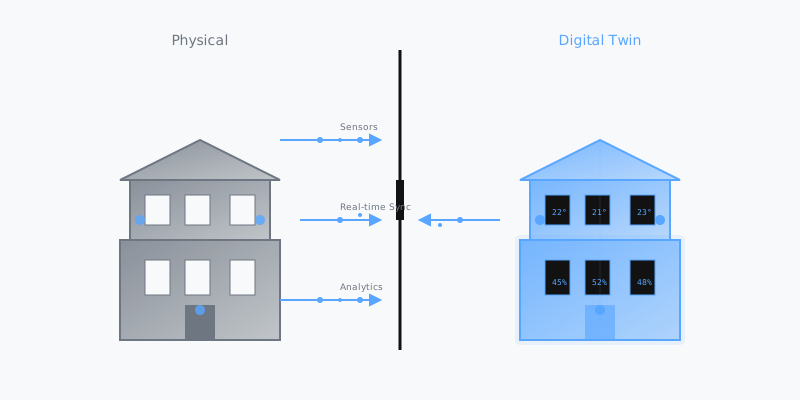
A digital twin is a continuously synchronized virtual representation of a physical system that enables:
- Understanding current state
- Predicting future behavior
- Optimizing operations
- Testing changes safely
The key word is synchronized. A static model is a snapshot. A digital twin is a living replica.
The Components That Matter
1. Geometric Foundation
You need accurate 3D geometry of the physical system. This comes from:
- As-built CAD/BIM models
- Reality capture (laser scanning, photogrammetry)
- Sensor-derived spatial data
The geometry isn’t just for visualization. It’s the coordinate system for everything else.
2. Sensor Integration
Physical systems don’t hold still. Your twin needs real-time data:
- Environmental sensors (temperature, humidity, air quality)
- Equipment sensors (power, vibration, flow rates)
- Occupancy and utilization data
- Process data from control systems
This is where most digital twin projects get stuck. Sensor integration is hard. Different protocols, different vendors, different data formats.
3. Physics Models
Raw sensor data tells you what is. Physics models tell you why and what’s next.
- Thermal models for HVAC optimization
- Structural models for load analysis
- Flow models for fluid systems
- Energy models for consumption prediction
The model fidelity depends on your questions. Simple queries need simple models. Optimization needs more.
4. Time Dimension
Digital twins exist in time, not just space:
- Historical data for pattern recognition and diagnostics
- Real-time data for current state awareness
- Predicted data for planning and optimization
Without the time dimension, you have a 3D dashboard, not a digital twin.
5. Decision Support
Data and models are useless without actionable insights:
- Anomaly detection and alerting
- Optimization recommendations
- What-if scenario analysis
- Automated control responses
The twin should make people (or systems) smarter about decisions.
Where Digital Twins Deliver Value
Facility Management
This is where I’ve seen the most mature implementations.
A real example: A major industrial facility with hundreds of thousands of square feet, thousands of pieces of equipment, and complex environmental requirements.
The digital twin:
- Tracks every asset location and status
- Monitors environmental conditions in real-time
- Predicts HVAC failures before they happen
- Optimizes energy usage based on occupancy and weather
- Enables remote diagnostics and maintenance planning
ROI comes from reduced downtime, lower energy costs, and extended equipment life.
Manufacturing
Factory digital twins coordinate:
- Production line configurations
- Robot cell layouts and programming
- Material flow optimization
- Quality prediction and control
Test changes virtually before disrupting production. Validate robot programs in simulation. Optimize throughput without trial and error on the factory floor.
Construction and Infrastructure
Buildings are complex systems. Digital twins help:
- During design: Energy modeling, clash detection, constructability analysis
- During construction: Progress tracking, logistics optimization
- During operation: Everything above in facility management
- During renovation: Accurate as-built data for planning
The value compounds over the building lifecycle.
Why Most Digital Twin Projects Fail
Starting with Technology, Not Problems
“We need a digital twin” isn’t a strategy. Which decisions do you need to make better? What information is missing? Where is money being lost?
Start with problems worth solving.
Underestimating Data Integration
The sexy part is the 3D visualization. The hard part is getting reliable data from heterogeneous systems.
Plan for data integration to take longer than expected. Budget accordingly.
Perfect Is the Enemy of Good
You don’t need every sensor and every physics model on day one. Start with the highest-value use cases. Expand based on proven returns.
Ignoring Maintenance
Digital twins require care and feeding:
- Sensor calibration and replacement
- Model updates as physical systems change
- Data pipeline maintenance
- Software updates
If you’re not budgeting for ongoing operations, you’re not serious.
Getting Started Right
Phase 1: Foundation
- Establish accurate geometric baseline
- Connect critical sensors
- Build basic visualization
- Prove data pipeline reliability
Phase 2: Intelligence
- Add physics models for priority systems
- Implement anomaly detection
- Enable historical analysis
- Train users on new capabilities
Phase 3: Optimization
- Predictive analytics for maintenance
- Automated optimization recommendations
- What-if scenario tools
- Integration with operations systems
Phase 4: Autonomy
- Closed-loop control where appropriate
- AI-driven optimization
- Continuous model improvement
- Extension to new use cases
The Platform Question
Building a digital twin from scratch is expensive and slow.
Building on a platform designed for digital twins—with built-in 3D capabilities, sensor integration patterns, physics hooks, and time-series handling—changes the economics entirely.
The question isn’t whether to build or buy. It’s whether your platform enables or constrains what’s possible.
Where This Goes
Digital twins are early. The tools are maturing. The integrations are getting easier. The AI capabilities are expanding rapidly.
In ten years, every significant physical system will have a digital twin. Not because it’s trendy, but because operating without one will be like running a business without software.
The organizations building these capabilities now are creating competitive advantages that compound.
The buzzword will fade. The value won’t.
Building digital twin capabilities? See how our platform helps →