The Collaboration Crisis in 3D Design
- Gerard Webb
- Industry , Architecture
- November 22, 2024
Table of Contents
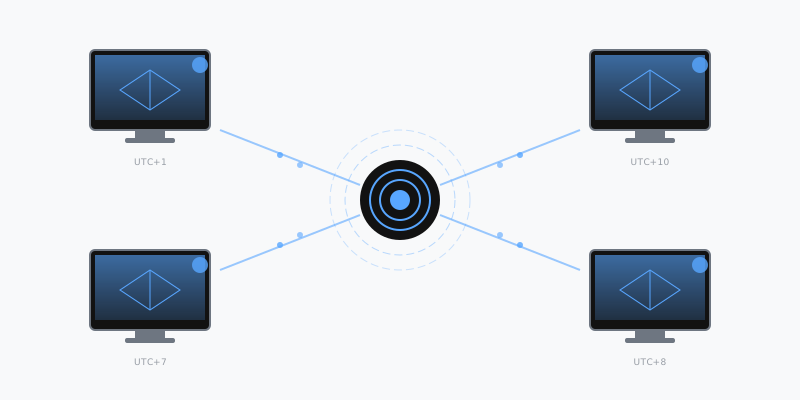
The factory floor is in Vietnam. The structural engineers are in Germany. The architects are in Australia. The client is in Singapore.
Everyone needs to work on the same model. Everyone needs to see the same current state. Everyone needs changes to propagate instantly.
And yet, in 2024, the dominant workflow is still: email a file, wait, hope nobody else changed anything, merge manually, repeat.
This is broken.
The File Problem
Traditional CAD was built around files. Save. Close. Email. Download. Open. Edit. Save. Email back.
Every handoff is a risk:
- “Which version is current?”
- “Did you see my changes from yesterday?”
- “We worked on the same section—now what?”
- “The file is locked—who has it?”
File-based collaboration doesn’t scale. Not across time zones. Not across organizations. Not at the speed modern projects demand.
The Merge Nightmare
When two engineers modify the same model, someone has to reconcile the differences.
In text (code), we have git. Diff, merge, resolve conflicts. It works—mostly.
In 3D geometry? The tools barely exist. Manual comparison. Visual inspection. Hoping you catch the discrepancies. Praying you don’t introduce errors.
Every merge is a risk. Every handoff is a potential disaster.
Why This Matters Now
The pressure is intensifying:
Projects are more distributed. COVID normalized remote work. Supply chains went global. The talent is everywhere—not in your office.
Timelines are compressed. Modular construction promises speed. Robotics deployment demands iteration. “We’ll sort it out in the field” doesn’t work when the factory is across the ocean.
Stakeholders multiply. Architects, engineers, manufacturers, clients, regulators—all need visibility. All need input. All need access to current state.
AI is coming. Soon it won’t just be humans collaborating. AI agents will participate in design. They need real-time access too.
The gap between what’s needed and what’s available is widening every year.
What Real Collaboration Requires
Real-Time Synchronization
Not “sync when you save.” Not “push when you’re done.” Continuous, live synchronization where changes appear as they’re made.
Someone moves a wall in Sydney? The engineer in Munich sees it happen. No delay. No merge. No conflict.
Offline-First Architecture
Real-time doesn’t mean always-connected. The factory floor has spotty wifi. The construction site has no signal. The plane has no internet.
True collaboration tools work offline and sync automatically when connectivity returns. Full capability, anywhere. Merge handled by the system, not the human.
Conflict Resolution That Actually Works
CRDT—Conflict-free Replicated Data Types. The computer science finally caught up with the need.
Automerge and similar technologies make it possible: multiple people editing simultaneously, automatic conflict resolution, no data loss, no manual merging.
This isn’t theoretical. It’s production-ready. It’s just not in your CAD system yet.
Open Standards
Collaboration across organizations means collaboration across software. Your architects use one tool. Your engineers use another. Your manufacturer uses a third.
Proprietary formats are collaboration killers. Open standards (STEP, IFC) are collaboration enablers.
Your model shouldn’t be trapped in one vendor’s ecosystem. Your collaboration shouldn’t depend on everyone buying the same software.
The Opportunity
Software developers solved this problem years ago. Git, GitHub, real-time collaboration in Google Docs—the patterns exist.
But 3D design tools didn’t keep up. The geometry is more complex. The legacy is deeper. The incentives favor lock-in over interoperability.
This is changing. The technologies are ready:
- Automerge CRDT for real-time, conflict-free collaboration
- NATS JetStream for distributed messaging at scale
- Open standards for interoperability
- Web-native architecture for universal access
What’s needed is someone to put it together. Purpose-built. AI-native. Collaboration-first.
Working with distributed teams on 3D design projects? See how we’re solving this →